

Until I was twelve years old, I studied in the French school system, where drama meant Molière, Corneille, Racine. Going to the theatre usually meant shows such as The Sound of Music or My Fair Lady. Then, a decision was made that I would switch to school in England. So, at age 13, I arrived at Westminster School. It was 1968, and the world opened up.
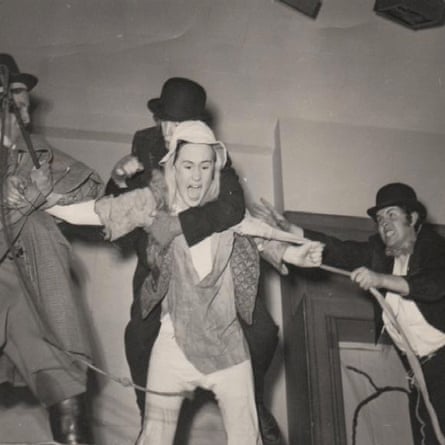
I went to see a school production of Waiting for Godot in French in a compact space with a modest platform, and I sat at the back. Musically, I was pretty sophisticated – I already knew all the psychedelic music that had been emerging. I’d experienced the Mothers of Invention. I’d seen lots and lots. But I was unaware there was material of this kind. I quickly realized that, similar to music, there was a completely different realm out there.
I am unsure how fluent the French was, but it wasn’t important what they were expressing. It was just so conceptual and lively, with a kind of built-up suspense. And then, of course, it erupts with Pozzo and Lucky’s arrival. The show was staged by senior students, including a talented actor as Lucky. He was a commanding figure on stage. And he must perform that highly elaborate speech. In French. It was astonishing.
I was captivated by the notion that very little needed to occur, you know? That an event took place and then it just goes on and then you have the young messenger at the end explaining that Godot won’t be coming today. It spoke about time and action and plot. Or the lack thereof.
We had been taught all these guidelines about what drama was, but they were irrelevant here. I was deeply intrigued by the minimal action. Much later when I was producing music, I would attempt to transform them into something comparable. When a fresh sound came in, I’d pull out other instruments and intentionally highlight them. So you clearly perceived that keyboard or that guitar or whichever element. That idea of minimalism … I grasped that with Godot.
And yet it has a story. It really does. I mean, they are fully realised characters. They are so alive, Vladimir and Estragon, in their mutual affection, like an old married couple. I can’t say how my life would have turned out if I hadn’t gone that performance. To that school and that show then. It just awakened something in me.
We were released on Saturday afternoons, and I began attending afternoon shows at the Royal Court every time there was a fresh staging. So you would see works by modern playwrights. But the entry point to all of this was Godot.
I have so little recollection of the performance itself, except I know that it was consistently engaging – it had me at the height of anticipation. What I took away is that there need not be any constraints. It definitely influenced how I collaborated with the bands that I brought into my label. I even had the musical group write a song around “I Can’t Go On, I’ll Go On”. I just instructed them: “I want a song with this title.”
I think it boosted my confidence, too, because you should not fret about failure if you embrace Beckett’s worldview.


